
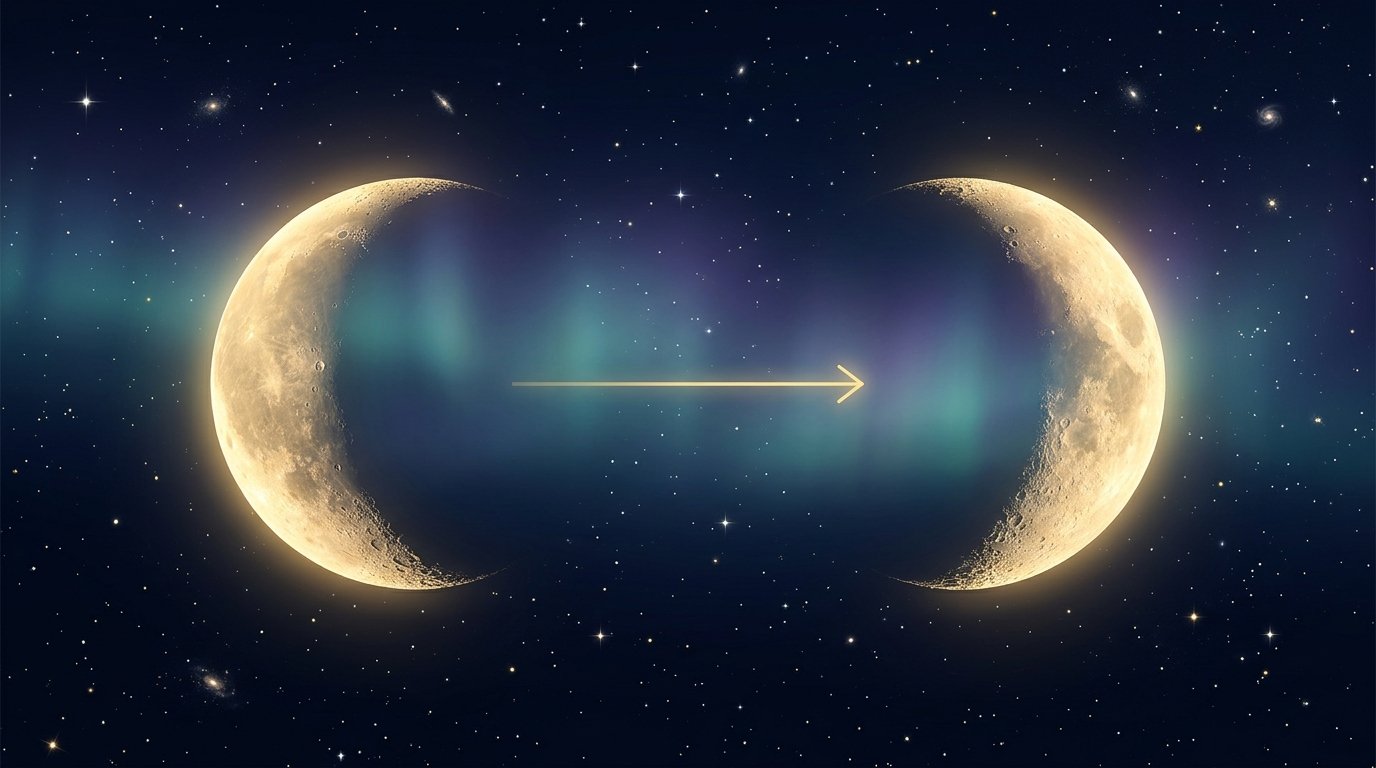
You step outside, spot a half-lit moon, and wonder: is it growing or shrinking? Plenty of people can spot a full moon but freeze when asked if it’s waxing or waning. You don’t need a telescope or an app to answer it. Below are five quick checks, including two that still work if you live near the equator, where the usual advice breaks down.
Waxing vs Waning in Plain English
Waxing means growing. The lit part of the moon gets bigger each night, from new moon to full moon, which takes about 14.8 days.
Waning means shrinking. The lit part gets smaller each night, from full moon back to new moon, another 14.8 days. Together they make one 29.5-day lunar cycle.
One detail most guides skip: these two words are mainly used for crescent and gibbous moons. New moon, quarter moons and full moon are single moments, not stretches of growing or shrinking. That gives four named phases:
- Waxing crescent 🌒 and waxing gibbous 🌔 (growing)
- Waning gibbous 🌖 and waning crescent 🌘 (shrinking)
Crescent means less than half is lit. Gibbous means more than half is lit.
Method 1: The Right-or-Left Rule (Northern Hemisphere)
If you live in the US, Canada, Europe, Pakistan, India or anywhere north of the tropics, look at which side glows:
- Lit on the right = waxing
- Lit on the left = waning
A handy memory trick is the word DOC. A moon shaped like a D is waxing, O is full, and C is waning.
Method 2: Flip It in the Southern Hemisphere
In Australia, South Africa, Argentina or New Zealand, the moon appears upside down compared with northern skies. The rule reverses: lit on the left = waxing, lit on the right = waning.
Close to the equator, a crescent often lies on its back like a bowl or a smile, so left and right tell you nothing. Use Method 3 or 4 instead.
Method 3: Follow the Glow to the Sun
This one works everywhere, because it explains why the moon looks the way it does. The bright edge of the moon always faces the Sun.
- After sunset, the Sun has just dropped below the western horizon, so the lit edge points west. The moon is waxing.
- Before sunrise, the Sun is about to rise in the east, so the lit edge points east. The moon is waning.
Once you picture the Sun below the horizon, you can’t mix them up.
Method 4: Use the Time of Day
A waxing moon rises in the afternoon and is high in the sky during the evening. A waning moon rises late at night, so you mostly see it in the early morning.
If you see a partly lit moon after dinner, it is almost certainly waxing. If you spot one in the sky after sunrise or while heading out for early prayers or a morning walk, it is waning.
Method 5: Compare Moon Age or Illumination
If the sky is cloudy, check the numbers. Moon age is the days since the last new moon:
- Under about 14.8 days = waxing
- Over about 14.8 days = waning
You can also compare today’s illumination percentage with yesterday’s. Higher means waxing, lower means waning. Our Moon Phase Today tool shows both instantly, and Moon Age Calculator lets you check any date.
Quick Reference
Why It’s Worth Knowing
- Stargazing: A waxing gibbous moon floods the evening sky with light. A waning moon rises late, so the early night stays dark.
- Photography: Thin crescents look best low on the horizon, after sunset (waxing) or before sunrise (waning).
- Gardening and fishing: Many traditions link moon phases to planting and fishing, but there is no strong evidence that moon phase alone predicts crop growth or fishing success.
- Tides: The biggest tides, called spring tides, happen around new and full moon.
Common Mistakes
- Using the “lit on the right” rule in the Southern Hemisphere.
- Calling a full moon “waxing”. It is neither.
- Mixing up crescent and gibbous. Count the lit area: less than half is crescent.
- Copying a moon emoji without checking your hemisphere. 🌒 and 🌘 look reversed from north to south.
FAQ
Is a waxing moon good or bad?
Neither. Waxing only describes the lit part growing. Any meaning beyond that comes from culture and tradition, not science.How long does the moon stay waxing?
About 14.8 days, from new moon to full moon.Is the moon waxing or waning tonight?
Use any method above, or open our live tool for an exact answer with illumination and moon age.Why does the moon look different in Australia?
Southern observers view the moon from the opposite orientation, so the lit side appears on the opposite side.Final Thoughts
Pick the trick that fits your location. The right-or-left rule is fastest in the north, while “follow the glow to the Sun” works anywhere on Earth. To skip the guesswork, check the live moon tracker for tonight’s exact phase.